VigorHorse Official Website › Blog › What 82 Milligrams Means
What 82 Milligrams Of Proprietary Blend Actually Means
This label does something most of its category will not: it prints a real Supplement Facts panel. That panel carries one active line, one total, and nine names underneath it. The arithmetic that follows is only possible because the seller published the number at all.
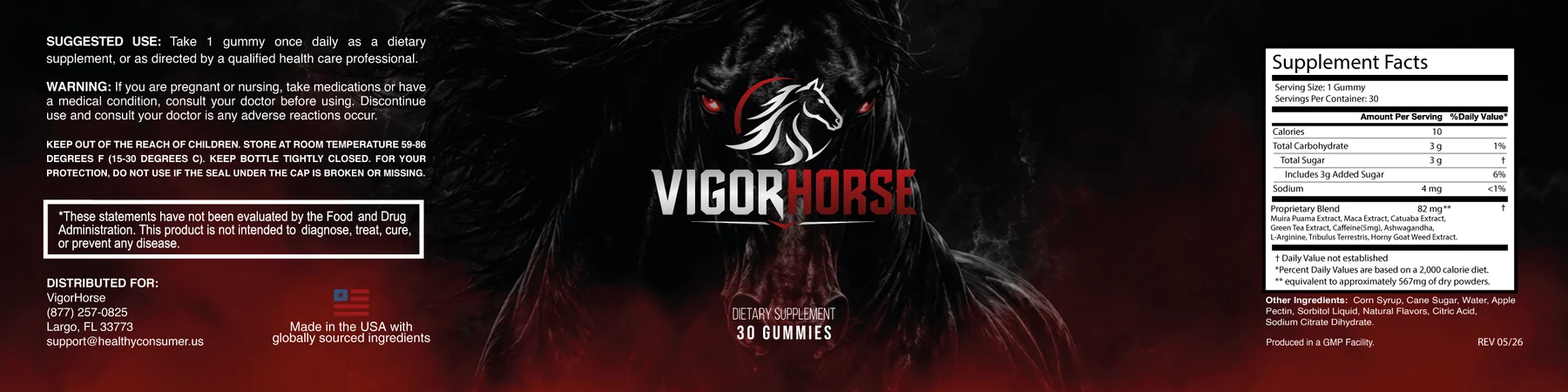
- The panel prints one active total: 82 mg, shared by 9 names.
- 82 mg is therefore a ceiling for all 9 at once. No single name can exceed it, and each is realistically a fraction of it.
- The one exception is caffeine, broken out at 5 mg, which is the only ingredient figure on the whole panel a reader can compare to anything.
- The smallest single-ingredient dose ever to produce a controlled result among these nine is 675 mg a day of ashwagandha root extract, over ninety days.
- A blend line is legal, common, and not in itself a trick. A small blend total is the thing that decides what the line can contain.
What a proprietary blend line is
A Supplement Facts panel normally lists each active ingredient on its own line with its own weight. A proprietary blend replaces that with a single line: one name, one total weight, and a list of what is in the mixture printed underneath in no particular order of quantity.
This is permitted. A manufacturer is entitled to keep the exact ratio of a formula confidential, and the requirement is only that the total is declared and the components are named. Thousands of products in every category on the shelf do exactly this.
What it costs the reader is specific rather than general. You still know everything that is in the product. What you lose is the one figure that decides whether a published trial has anything to say about the jar in your hand.
What you can still work out
Rather more than most people assume. The total is a hard ceiling, so no component can exceed it. The order of the names usually follows descending weight, which is conventional rather than mandatory. And any component broken out with its own figure, as the caffeine is here, is exact.
Why one total is a ceiling for nine names
Here is the whole of the logical step, and it is short. If 9 substances together weigh 82 mg, then no one of them weighs more than 82 mg. That is not an inference about this product. It is what the word total means.
Divide evenly and each name gets about 9 mg. That even split is the most generous assumption available, because blends are usually ordered by descending weight, which means the first name carries more than 9 mg and the last few carry considerably less.
So the useful reading of this panel is not 9 ingredients at unknown amounts. It is 9 ingredients, none of which can exceed 82 mg, and most of which are in single figures.
The arithmetic, in one table
Set that ceiling beside the amounts the published trials used and the comparison completes itself. Nothing in the right-hand column below is a prediction about this gummy. Each figure is what a specific trial gave a specific group of people.
| Name on the blend line | Amount the panel gives it | Daily amount that produced a controlled result |
|---|---|---|
| Ashwagandha | Share of 82 mg | 675 mg for 90 days |
| Maca extract | Share of 82 mg | 1,500 to 3,000 mg for 12 weeks |
| Tribulus terrestris | Share of 82 mg | 1,500 mg, taken as six 250 mg tablets |
| L-arginine | Share of 82 mg | 5,000 mg for six weeks; 1,500 mg as the pooled floor |
| Muira puama extract | Share of 82 mg | No controlled trial in men at any dose |
| Catuaba extract | Share of 82 mg | No human trial at all |
| Horny goat weed extract | Share of 82 mg | No human trial for this use |
| Green tea extract | Share of 82 mg | Safety literature rather than efficacy |
| Caffeine | 5 mg, printed | Up to 400 mg is the healthy-adult ceiling |
The middle column is what the panel permits, not a measurement. The right column is what the published trials gave, read from the abstracts themselves.
Four of the nine names have a controlled human trial behind them. The ashwagandha fertility trial ran 675 mg a day for ninety days. The maca desire trial ran 1,500 mg and 3,000 mg a day for twelve weeks. The tribulus trial that reported a result used 1,500 mg a day, taken as six separate tablets. The original L-arginine crossover gave 5,000 mg a day, and the later meta-analysis put the working range at 1,500 to 5,000 mg.
The remaining five have either no human trial for this purpose or safety literature rather than efficacy literature, which is covered in the guide rather than repeated here.
| The arithmetic | Figure |
|---|---|
| Blend total printed on the panel | 82 mg |
| Names sharing that total | 9 |
| Average if the blend were split evenly | About 9 mg each |
| Smallest single-ingredient trial dose among the nine | 675 mg of ashwagandha |
| That trial dose as a multiple of the whole blend | A little over 8 times |
| The blend's dry-powder equivalent, per the panel footnote | About 567 mg |
| The same trial dose against that equivalent | Still larger, by about a fifth |
An even split is the most generous assumption available. Blends are usually ordered by weight, so the last names on the line carry less than the average, not more.
The 567 mg footnote, and what it does not fix
The panel's blend line carries a footnote worth reading carefully: the 82 mg is described as equivalent to approximately 567 mg of dry powders.
That is a meaningful piece of information and it deserves to be taken at face value. It says the blend is built from concentrated extracts, and that if you reconstituted those extracts back into the raw plant material they came from, you would have roughly 567 mg of it. Extract ratios are real and a 7:1 extract genuinely does carry more active material than the same weight of powder.
It does not, however, rescue the arithmetic, for two reasons. The first is that 567 mg shared by 9 names is about 63 mg each, still an order of magnitude below the trial doses in the table above. The second is that the trials themselves mostly used extracts too. Ashwagandha's 675 mg was root extract, not raw root, so comparing this blend's extract weight against that trial's extract weight is the like-for-like comparison, and it is the one in the table.
675 mg of ashwagandha root extract, on its own, is a little over eight times this jar’s entire 82 mg blend, and about a fifth more than its 567 mg dry-powder equivalent. That is the whole of the dosage point on this website, and it is made here and in the honest dosage section of the ingredients page, not on every page.
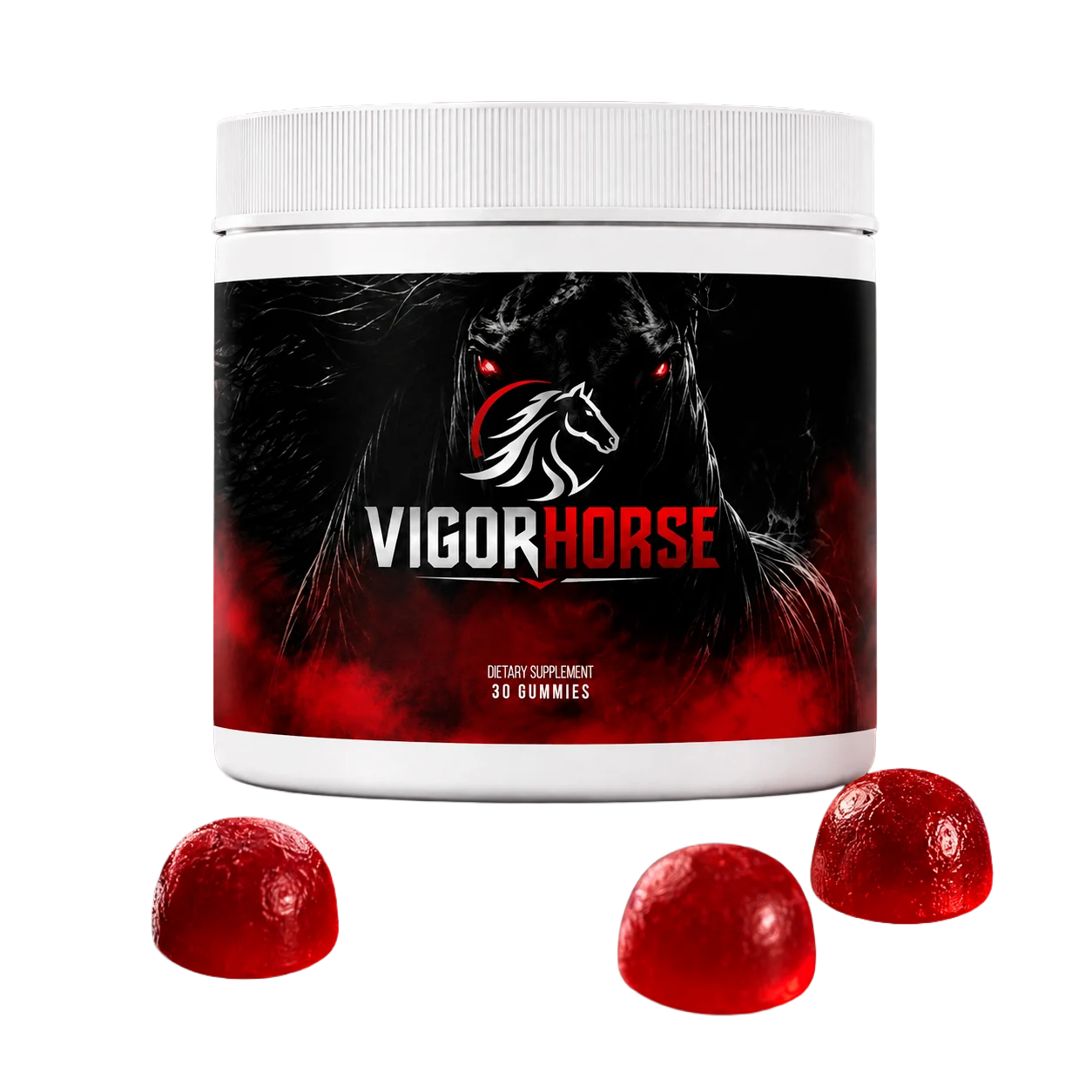
The VigorHorse panel is published in full on this website
Every printed row, the blend line, the 9 names beneath it and the three footnotes, transcribed from the artwork exactly as it prints them.
One bottle $89 · six bottles $294 · 60-day money-back guarantee
Order VigorHorse On The Official WebsiteOne gummy a day · 30 per jar · lot VIG-26/GO-6654
What the caffeine row proves the label could do
The most interesting thing on this panel is the exception. Of the 9 names on the blend line, one carries its own figure: caffeine, at 5 mg.
That single disclosure is doing more work than the seller probably intended. It demonstrates that breaking a component out of a blend line is possible, permitted, and compatible with keeping the rest of the ratio confidential. The label already does it once.
It is also the only ingredient figure on the whole panel that can be placed against anything. A 5 oz cup of ground roasted coffee is about 85 mg, so 5 mg is roughly one seventeenth of a cup. That is a small, honest, checkable number, and it is checkable precisely because it was broken out.
What a blend line is actually for
Two reasons get given and both are real.
The first is competitive. A formula that took work to arrive at can be copied from a panel in an afternoon if every ratio is printed. Keeping the proportions confidential is a legitimate commercial interest, and it is the reason the rule permits blends at all.
The second is less flattering and also common: a blend line makes a small total look like a long ingredient list. Nine names reads as a comprehensive formula. Nine names sharing 82 mg reads as something else, and only one of those two sentences appears on a sales page.
Which of the two applies to any given product is not knowable from the outside. What is knowable is the total, and that is the number to act on.
What this does not mean
Three things worth saying plainly, because a dosage argument is easy to overrun.
It does not mean the product does nothing for anybody. It means the single-ingredient trials cannot be used as a prediction about it, which is a narrower claim and the only one the arithmetic supports.
It does not mean the seller has hidden anything. The opposite: the panel is printed, the total is there, the caffeine is broken out and the extract footnote is given. Most of this category publishes no panel at all, and on products like that none of the work on this page is even possible.
- A ceiling is a fact about the formula, not an accusation about the seller.
- Extract concentration is real and the footnote acknowledging it is a point in the label’s favour.
- The caffeine disclosure is a genuine piece of transparency and the reason one row on this panel can be checked.
- Nothing here concerns safety. A small botanical dose is a question about effect, not about risk.
Four questions for any blend line
- What is the total? Everything else follows from it. Write the number down before reading any of the names.
- How many names share it? Divide. The result is the most generous possible average, and the real figures descend from there.
- Is anything broken out? Any component with its own figure is exact, and it tells you the manufacturer was willing to disclose when it suited them.
- What did the trials use? If the answer is grams and the blend total is double figures, the citations on the sales page are context about the ingredients rather than evidence about the serving.
Those four take about two minutes on any label in any aisle, and they are the same four the seven-check scorecard opens with.
References
- Ambiye VR, Langade D, Dongre S, et al. Clinical Evaluation of the Spermatogenic Activity of the Root Extract of Ashwagandha (Withania somnifera) in Oligospermic Males: A Pilot Study. Evid Based Complement Alternat Med. 2013;2013:571420. PMID 24371462. https://pubmed.ncbi.nlm.nih.gov/24371462/
- Gonzales GF, Cordova A, Vega K, et al. Effect of Lepidium meyenii (MACA) on sexual desire and its absent relationship with serum testosterone levels in adult healthy men. Andrologia. 2002;34(6):367-72. PMID 12472620. https://pubmed.ncbi.nlm.nih.gov/12472620/
- Kamenov Z, Fileva S, Kalinov K, et al. Evaluation of the efficacy and safety of Tribulus terrestris in male sexual dysfunction - A prospective, randomized, double-blind, placebo-controlled clinical trial. Maturitas. 2017;99:20-26. PMID 28364864. https://pubmed.ncbi.nlm.nih.gov/28364864/
- Rhim HC, Kim MS, Park YJ, et al. The Potential Role of Arginine Supplements on Erectile Dysfunction: A Systemic Review and Meta-Analysis. J Sex Med. 2019;16(2):223-234. PMID 30770070. https://pubmed.ncbi.nlm.nih.gov/30770070/
- Chen J, Wollman Y, Chernichovsky T, et al. Effect of oral administration of high-dose nitric oxide donor L-arginine in men with organic erectile dysfunction: results of a double-blind, randomized, placebo-controlled study. BJU Int. 1999;83(3):269-73. PMID 10233492. https://pubmed.ncbi.nlm.nih.gov/10233492/
- Barone JJ, Roberts HR. Caffeine consumption. Food Chem Toxicol. 1996;34(1):119-29. PMID 8603790. https://pubmed.ncbi.nlm.nih.gov/8603790/