VigorHorse Official Website › Blog › Ashwagandha And The Sixty-Day Trials
Ashwagandha And The Sixty-Day Trials: What Was Measured, At What Dose, From Which Part
Two well-known ashwagandha trials ran for exactly sixty days, the same length as the guarantee on this jar. That coincidence deserves a careful look, because almost everything else about them differs from the gummy: the dose, the people, the outcome and the part of the plant.
- Two randomised, placebo-controlled trials each ran 60 days: 240 mg a day of a standardised extract in 60 stressed adults, and 300 mg twice a day of a root extract in 64 adults with chronic stress.
- Both measured stress, anxiety and cortisol, not vitality. In the 240 mg trial, testosterone rose in the men over time, but the change was not significant against placebo (P = .158).
- Two pooled analyses report falls in stress and anxiety scores. One also reports very high heterogeneity and rates its certainty low, and its dose-response curve for stress sits at 300 to 600 mg a day.
- Ashwagandha is printed after the 5 mg caffeine figure, so it weighs 5 mg or less per gummy, which is 48 to 120 times below the trial doses.
- A 2026 analysis of 25 supplements found only two confirmed as root-derived, the rest holding varying proportions of aerial parts, disclosed or not. This label names no part.
Two trials that lasted exactly as long as the guarantee
The seller's guarantee on this jar runs 60 days from the date of purchase. Two of the best-known ashwagandha trials ran for 60 days too, and that is worth stopping on, because it is the kind of match a sales page might quietly lean on.
The first was published in Medicine in 2019. It was a 60-day, randomised, double-blind, placebo-controlled study in 60 adults with self-reported high stress, who took either placebo or 240 mg of a standardised ashwagandha extract, Shoden by name, once a day. The second, published in the Indian Journal of Psychological Medicine in 2012, enrolled 64 people with a history of chronic stress. They took one capsule twice a day for 60 days, and each capsule held 300 mg of a high-concentration full-spectrum extract from the root, so 600 mg a day in total.
Both studies were designed to ask whether ashwagandha reduces stress. Neither was designed to ask whether it changes vitality, libido or stamina, and neither enrolled people because of any of those. That matters for what follows, because the label on this jar names circulation, libido, stamina and male vitality and says nothing about stress. This article does not claim the jar lowers stress. It asks what the evidence for the ingredient looks like when you read it as written.
What they measured
| 2019 trial | 2012 trial | |
|---|---|---|
| People | 60 adults with self-reported high stress | 64 adults with a history of chronic stress |
| Material | 240 mg a day of a standardised extract | 600 mg a day (2 x 300 mg) of a high-concentration full-spectrum root extract |
| Anxiety and stress scales | Anxiety rating scale down versus placebo (P = .040); DASS-21 near-significant (P = .096) | All stress-assessment scales down versus placebo (P < 0.0001) |
| Cortisol | Morning cortisol down versus placebo (P < .001); DHEA-S also down (P = .004) | Serum cortisol down versus placebo (P = 0.0006) |
| Adverse events | None reported; all 60 completed | Mild, and comparable between groups; none serious |
P-values as the abstracts state them. The 2012 study was single-centre. Neither measured erectile function, desire or stamina.
On its own terms, that is a tidy result. Both trials found lower cortisol in the ashwagandha group, and the first suggests the effect might run through the hypothalamic-pituitary-adrenal axis, the body's stress-hormone system, while asking for larger and more varied samples. Note the way the first trial's own abstract handles its second scale: DASS-21, a broader stress and depression questionnaire, reached P = .096 and is described as near-significant. That is an honest sentence and it is not the same as significant.
The testosterone line, read exactly
Ashwagandha is often sold with a testosterone story attached, and men reading a vitality label are entitled to ask whether these trials support it. The 2019 trial is the one that measured it, and its abstract is careful.
It reports that testosterone levels increased in males, with P = .038 across the study, but not in females. It then adds, in the next clause, that the change was not statistically significant compared with placebo (P = .158). In other words, the number went up in the men who took the extract, but the rise could not be statistically separated from the change in the placebo group. The authors do not present it as an answer, and they call for larger samples and different dosing before drawing one.
Within-group and between-group are different comparisons. A hormone moving in the treated group tells you something changed over 60 days. Only the comparison against placebo tells you whether the treatment did it. On testosterone, the one 60-day trial that measured it found the first and not the second.
Pooled, and what pooling shows
A single trial is a data point. Two later meta-analyses tried to add the trials together.
A 2022 review in Phytotherapy Research pooled 12 randomised trials with 1,002 participants and found that ashwagandha reduced anxiety (standardised mean difference -1.55) and stress (-1.75) compared with placebo. Its dose-response analysis suggested a benefit for stress at 300 to 600 mg a day. But it also reports very high heterogeneity, 93.8% for anxiety and 83.1% for stress, which means the trials disagreed with each other on how large the effect was, and it rates the certainty of the evidence as low for both outcomes.
A 2024 meta-analysis in Explore pooled nine trials with 558 patients. It found significant effects on the Perceived Stress Scale (mean difference -4.72), the Hamilton Anxiety scale (-2.19) and serum cortisol (-2.58). Four of the nine trials reported mild to moderate adverse events, and the authors say that further information is needed on long-term safety.
Put those side by side and the summary is fair rather than glowing. The direction of the evidence is consistent. The size of the effect varies a lot between trials. The certainty is low. The best supported dose range for stress is in the hundreds of milligrams. And every one of those trials is about stress, not about the things a men's vitality label names.
Why 240 mg and 600 mg are not the same currency
It is tempting to treat those two doses as points on one scale, so it is worth saying why they are not. The 2019 trial used a standardised extract, meaning a manufacturer adjusts the extract so a marker compound sits at a stated level. The 2012 trial used a high-concentration full-spectrum extract, which is a different way of describing a different product. Neither abstract gives the marker percentage, and each was made by a different process.
That is why the pooled reviews can only speak of “ashwagandha extract” loosely, and why the dose-response finding, a stress benefit at 300 to 600 mg a day, should be read as a range across mixed products rather than a target for any one of them. A milligram of one extract is not a milligram of another. It also means that when a label prints just the plant's name, there is no way to convert a trial dose into a comparable jar dose, even in principle.
Five questions for any ashwagandha trial, or any label
- Who took part? Both sixty-day trials enrolled stressed adults. A trial in stressed adults tells you about stressed adults.
- Which material? A brand-named standardised extract, or a described root extract, is a different thing from an unspecified “ashwagandha”.
- How much? Hundreds of milligrams a day in the pooled dose-response, against a shared blend total of 82 mg here.
- What was measured? Stress and anxiety scales and cortisol. Vitality, libido and stamina were not the endpoints.
- Against what? Placebo, which matters on any outcome that moves by itself. The testosterone line is the worked example of why.
Run any trial, or any label, through those five and you will know quickly how much of the evidence really applies to the thing in your hand. For this jar the honest answer is: some of it, loosely, and not the parts a sales page would most like you to hear.
Sixty days, judged fairly
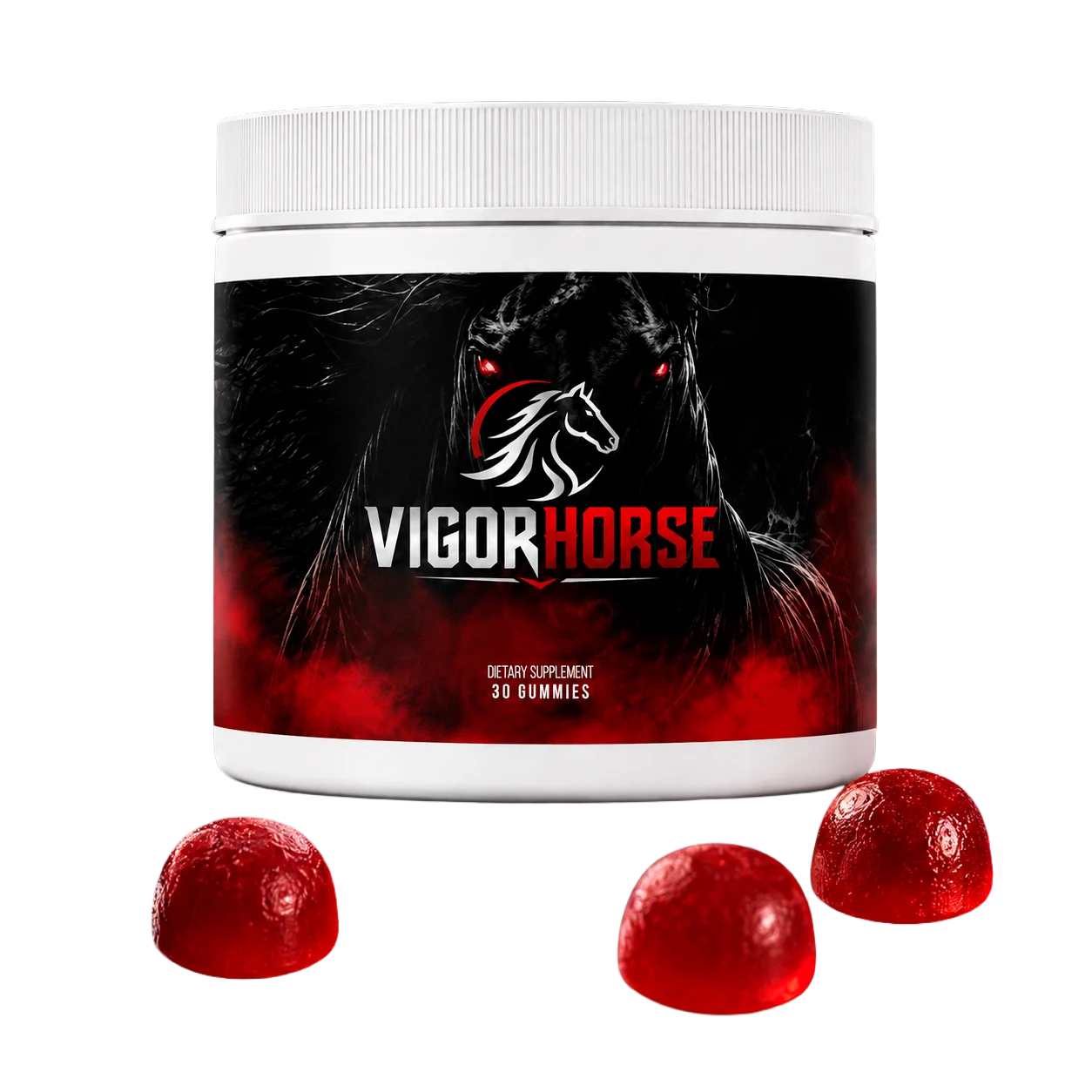
One gummy a day, 30 to a jar, and 60 days from the date of purchase to find out what the jar does for you, not what a trial did for someone else.
One bottle $89 · six bottles $294 · 60-day money-back guarantee
Order VigorHorse On The Official WebsiteOne gummy a day · 30 per jar · lot VIG-26/GO-6654
Where the jar sits against those doses
Now put the label next to the trials. Ashwagandha is sixth of nine names, printed after caffeine, and caffeine is printed at 5 mg. Names on a proprietary blend are listed in descending order of predominance by weight, so anything after the 5 mg figure weighs 5 mg or less. The whole blend is 82 mg for all nine names.
| What the trial or paper used | Amount a day | Times the most this jar can hold (5 mg) | Times the whole 82 mg blend |
|---|---|---|---|
| 2019 trial, standardised extract | 240 mg | 48 | About 2.9 |
| Start of the pooled stress dose range | 300 mg | 60 | About 3.7 |
| 2012 trial, full-spectrum root extract | 600 mg | 120 | About 7.3 |
One gummy a day. The 567 mg footnote on the panel describes the dry-powder equivalent of the whole nine-name blend, not of ashwagandha.
Even if the entire blend were ashwagandha extract, the trial doses would be roughly three to seven times the jar. Because it is a shared blend, the real gap is 48 to 120 times. That is the arithmetic, and it is the same arithmetic that runs through the 82 milligrams article. The fair statement is not that the ingredient does nothing. It is that the trials describe a different amount of a different, better-described material.
Which part of the plant? The label does not say
The 2012 trial names its material: an extract from the root. The 2019 abstract names a standardised extract and a brand. The jar says one word, “Ashwagandha”. Does it matter?
A 2026 paper in Phytotherapy Research says yes. It compared British and US Pharmacopoeia methods for quantifying three steroidal compounds in ashwagandha samples and in 25 supplements sold in commerce. Two figures from the abstract stand out. More than 44% of the products failed the British standard and 60% failed the US standard, largely because leaf material carries a compound that co-elutes with one of the markers and distorts the measurement. And only 10 of the 25 supplements met both standards; only two were confirmed as root-derived, and the remainder contained varying proportions of disclosed or undisclosed aerial parts.
The authors note that the commercial use of aerial parts, despite traditional root-only use and clear chemical differences, raises concerns about quality and safety, and they call for rigorous source verification. The ingredients page on this website states that the trial evidence is for root extract and that leaf preparations are a separate thing. That is exactly why the missing word matters: a label that says only “Ashwagandha” does not tell you which of the two you are holding, and nothing on the jar lets you check.
A short, honest paragraph on safety
Neither sixty-day trial reported a serious problem, and one pooled review says four of its nine trials reported adverse events that were mild to moderate. Ashwagandha also has a safety literature of a different kind. A 2020 case series described five people in Iceland and the US Drug-Induced Liver Injury Network with liver injury attributed to ashwagandha-containing supplements, usually cholestatic or mixed, with jaundice and itching, and liver tests returning to normal within one to five months in four of the five. A 2023 series from India reported eight patients with liver injury attributable to single-ingredient ashwagandha formulations, cholestatic hepatitis being the commonest picture; five had underlying chronic liver disease, and the three who presented with acute-on-chronic liver failure died.
These are case series, so they carry no denominator and cannot give a rate. The abstracts do not state the amounts involved, so nothing in them can be compared directly with 5 mg or less as one share of a nine-name blend, and nothing in them was about a gummy of this design. They are a reason for anyone with existing liver disease to ask a clinician before taking any ashwagandha product, and the label says as much in general terms: consult your doctor if you take medications or have a medical condition.
What the sixty-day match does and does not mean
Back to the coincidence we started with. It is true that the guarantee window and the two trials are the same length. It is true that a jar is 30 gummies and the guarantee covers a first jar and most of a second. The distributor's summary says buyers reach their verdicts between day 29 and day 60, and the results timeline page on this website lines that up with trial lengths generally.
What the match cannot do is turn a 30-gummy jar into a replication of a trial. The calendar is the same. The dose, the population, the outcome and the plant part are all different, and one of them, the part, is not printed. If you use the sixty days well, and the results timeline explains how, the honest thing you will learn is whether the jar does anything for you. What you will not learn is whether ashwagandha at trial doses does, because you did not take that. Nor can the guarantee window tell you anything about the plant part, the extract or the exact amount, since none of those is printed for you to compare.
240 to 600 mg of a described ashwagandha extract, taken for 60 days by people with stress, reduced stress scores and cortisol in two trials. This jar carries 5 mg or less of an unspecified ashwagandha among nine names, and makes no claim about stress. Both statements are true, and neither is a criticism of the other.
References
- Lopresti AL, Smith SJ, Malvi H, et al. An investigation into the stress-relieving and pharmacological actions of an ashwagandha (Withania somnifera) extract: A randomized, double-blind, placebo-controlled study. Medicine (Baltimore). 2019;98(37):e17186. PMID 31517876. https://pubmed.ncbi.nlm.nih.gov/31517876/
- Chandrasekhar K, Kapoor J, Anishetty S. A prospective, randomized double-blind, placebo-controlled study of safety and efficacy of a high-concentration full-spectrum extract of ashwagandha root in reducing stress and anxiety in adults. Indian J Psychol Med. 2012;34(3):255-62. PMID 23439798. https://pubmed.ncbi.nlm.nih.gov/23439798/
- Akhgarjand C, Asoudeh F, Bagheri A, et al. Does Ashwagandha supplementation have a beneficial effect on the management of anxiety and stress? A systematic review and meta-analysis of randomized controlled trials. Phytother Res. 2022;36(11):4115-4124. PMID 36017529. https://pubmed.ncbi.nlm.nih.gov/36017529/
- Arumugam V, Vijayakumar V, Balakrishnan A, et al. Effects of Ashwagandha (Withania Somnifera) on stress and anxiety: A systematic review and meta-analysis. Explore (NY). 2024;20(6):103062. PMID 39348746. https://pubmed.ncbi.nlm.nih.gov/39348746/
- Avula B, Katragunta K, Tatapudi KK, et al. A Comparison of British and US Pharmacopoeia Standards for Quality of Ashwagandha Dietary Supplements in Commerce. Phytother Res. 2026;40(8):4833-4844. PMID 41386716. https://pubmed.ncbi.nlm.nih.gov/41386716/
- Björnsson HK, Björnsson ES, Avula B, et al. Ashwagandha-induced liver injury: A case series from Iceland and the US Drug-Induced Liver Injury Network. Liver Int. 2020;40(4):825-829. PMID 31991029. https://pubmed.ncbi.nlm.nih.gov/31991029/
- Philips CA, Valsan A, Theruvath AH, et al. Ashwagandha-induced liver injury-A case series from India and literature review. Hepatol Commun. 2023;7(10). PMID 37756041. https://pubmed.ncbi.nlm.nih.gov/37756041/