VigorHorse Official Website › Blog › Five Milligrams Of Caffeine
Five Milligrams Of Caffeine, Put In Context
One number on this panel can be compared to something you already know. It is the caffeine, and at five milligrams it is about one seventeenth of a cup of coffee. Here is what that scale means, and why the row directly above it deserves more attention than it usually gets.
- Each gummy carries 5 mg of caffeine, printed on the panel as its own figure.
- A 5 oz cup of ground roasted coffee is about 85 mg, so one gummy is roughly one seventeenth of a cup.
- The standard review puts up to 400 mg a day in the range not associated with adverse effects in healthy adults. One gummy is one eightieth of that.
- The row worth more attention is the sugar: 3 g of added sugar per gummy, which is 90 g over a month of daily use.
- Green tea extract shares the blend line with the caffeine, and its published literature is about safety at high intakes rather than effect.
The one number on this panel you can place
This label prints a Supplement Facts panel with a single active line on it: a proprietary blend at 82 mg, carrying 9 names. Eight of those names have no amount of their own. The ninth does.
Caffeine is broken out at 5 mg, inside the blend line, in brackets. That makes it the only ingredient figure on the entire panel that a reader can set beside anything else, and it is worth doing precisely because everything else on the line resists the exercise.
The rest of this post is that comparison, and then the row above it, which is the one most people skip and the one that accumulates.
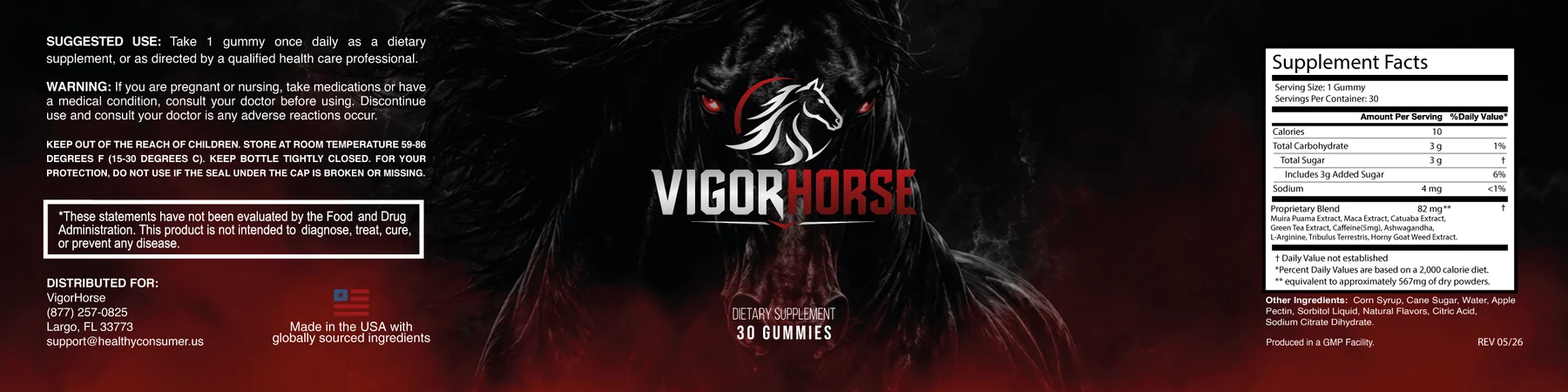
Five milligrams against a cup of coffee
The reference figure for brewed coffee is about 85 mg for a 5 oz cup of ground roasted coffee. That is the standard comparison point and it has been for decades.
So one gummy at 5 mg is roughly one seventeenth of that cup. Put differently, you would need seventeen gummies to match one modest cup of coffee, and the label asks for one a day.
| Source | Caffeine | As a multiple of this gummy |
|---|---|---|
| One VigorHorse gummy | 5 mg | 1x |
| A 5 oz cup of ground roasted coffee | About 85 mg | About 17x |
| A mug of black tea | Roughly 40 to 50 mg | About 8 to 10x |
| A 12 oz cola | Roughly 30 to 40 mg | About 6 to 8x |
| The healthy-adult daily figure in the standard review | Up to 400 mg | 80x |
The coffee and the 400 mg figure are cited below. The tea and cola rows are ordinary reference ranges included so the scale reads properly, and they vary with preparation.
The practical conclusion is that the caffeine in this product is a flavour-adjacent trace rather than a functional dose. It is not there to wake anybody up, and at this amount it could not.
Where the 400 mg figure comes from
The number most often quoted for caffeine has a source worth naming, because it gets repeated far more often than it gets cited.
Nawrot and colleagues reviewed the effects of caffeine on human health and concluded that intakes of up to 400 mg a day are not associated with adverse effects in healthy adults. Lower figures apply in pregnancy and for children, and the review sets those out separately.
That is the review the agencies cite when they publish the same number, and it is the one cited here. Against it, one gummy at 5 mg is one eightieth of the daily figure. Even somebody taking the gummy alongside three cups of coffee has not moved meaningfully closer to it because of the gummy.
What five milligrams can and cannot do
Being plain about a small number cuts both ways, and both directions are worth stating.
It cannot deliver a stimulant effect. Perceptible alertness effects in the literature start at intakes many times 5 mg, and nobody who has had a cup of tea in the same day would be able to tell this gummy apart from a placebo on that measure.
It also cannot realistically cause a problem in a healthy adult. A trace this size is below the amount in a cup of decaffeinated coffee, and below what a bar of dark chocolate supplies.
- As a stimulant: 5 mg is not a functional dose and the label does not present it as one.
- As a risk: a trace below the level in decaffeinated coffee, for a healthy adult.
- As a disclosure: genuinely useful, because it is the one row on this panel that can be checked.
- As evidence about the rest of the blend: none at all. Breaking out one component tells you nothing about the other eight.

Every VigorHorse panel row is published on this website
The nutrition rows, the blend line, the nine names and all three of the panel's own footnotes, transcribed from the artwork.
One bottle $89 · six bottles $294 · 60-day money-back guarantee
Order VigorHorse On The Official WebsiteOne gummy a day · 30 per jar · lot VIG-26/GO-6654
The row directly above it
Here is the part of the panel that matters more than the caffeine and gets a fraction of the attention.
This is a chewable gummy, which means it has to taste of something, which means sugar. The panel is straightforward about it: 3 g of total sugars per gummy, of which 3 g is added sugars, carrying 6% of the Daily Value.
Notice that the total carbohydrate row is also 3 g. The whole of the carbohydrate in this product is added sugar. There is no fibre or starch making up part of it.
| What the panel prints, per gummy | Amount | Percent Daily Value |
|---|---|---|
| Calories | 10 | — |
| Total Carbohydrate | 3 g | 1% |
| Total Sugars | 3 g | Daily Value not established |
| Includes Added Sugars | 3 g | 6% |
| Sodium | 4 mg | Under 1% |
| Proprietary Blend | 82 mg | Daily Value not established |
Transcribed from the label artwork. All three of the sugar rows carry the same figure, which means the whole of the carbohydrate in this gummy is added sugar.
Three grams a day is ninety grams a month
Three grams sounds like nothing, and as a single serving it more or less is. The reason to read the row is that this product is taken every day for months, and a daily figure multiplies.
Thirty gummies to a jar, one a day, is 90 g of added sugar per jar. The six-jar pack the seller promotes hardest is six months of daily use, which is about 540 g of added sugar across that period.
The 2021 American Heart Association dietary guidance sets out why added sugar is tracked separately from total carbohydrate, and the cohort work on added sugar and cardiovascular mortality is the outcome literature behind that. Neither is about supplements, and that is rather the point: a daily gummy is a daily added-sugar source and counts in the same column as any other.
For most people 3 g a day is a rounding error against everything else in a diet. For anybody counting added sugar deliberately, for diabetes or for weight, it is a real row on a real ledger and it should be entered rather than waved past. The panel prints it, which makes that easy.
The green tea sitting beside the caffeine
Green tea extract is one of the 9 names on the blend line, and it is worth a paragraph here rather than in the ingredient guide, because it is the reason the caffeine is present at all. Caffeine occurs naturally in green tea, and a green tea extract contributes some.
The published literature on concentrated green tea extract is mostly about safety rather than effect. The United States Pharmacopeia review examined liver signals associated with green tea extract in detail, and the NCCIH summary is the readable version of the same material.
The case reports in that literature involve daily catechin intakes from around 140 mg upward, which is far above anything a share of an 82 mg blend could supply. The honest reading is that this row is too small to be an efficacy question and too small to be a safety question, and the ceiling arithmetic is why both halves of that sentence are true.
Who should still think about five milligrams
Three groups, and it is a short list precisely because the number is small.
- Anyone genuinely caffeine sensitive. A handful of people react to amounts most would not notice. If that is you, you already know, and the panel gives you the figure to work with rather than leaving you guessing.
- Anyone taking it in the evening. The label does not specify a time of day. Five milligrams is unlikely to affect sleep, and taking it in the morning removes the question entirely at no cost.
- Anyone stacking several supplements. Trace caffeine appears across a lot of products and it is additive. One gummy is negligible; one gummy plus a pre-workout plus a fat burner is a different sum, and worth adding up once.
For everybody else, this row is a curiosity rather than a consideration, and the useful thing about it is not the caffeine at all. It is that the label was willing to print a number, which is what makes this post possible and what the post on the blend total asks for across the other eight names.
References
- Barone JJ, Roberts HR. Caffeine consumption. Food Chem Toxicol. 1996;34(1):119-29. PMID 8603790. https://pubmed.ncbi.nlm.nih.gov/8603790/
- Nawrot P, Jordan S, Eastwood J, et al. Effects of caffeine on human health. Food Addit Contam. 2003;20(1):1-30. PMID 12519715. https://pubmed.ncbi.nlm.nih.gov/12519715/
- Lichtenstein AH, Appel LJ, Vadiveloo M, et al. 2021 Dietary Guidance to Improve Cardiovascular Health: A Scientific Statement From the American Heart Association. Circulation. 2021;144(23):e472-e487. PMID 34724806. https://pubmed.ncbi.nlm.nih.gov/34724806/
- Yang Q, Zhang Z, Gregg EW, et al. Added sugar intake and cardiovascular diseases mortality among US adults. JAMA Intern Med. 2014;174(4):516-24. PMID 24493081. https://pubmed.ncbi.nlm.nih.gov/24493081/
- National Center for Complementary and Integrative Health. Green Tea: Usefulness and Safety. https://www.nccih.nih.gov/health/green-tea
- Oketch-Rabah HA, Roe AL, Rider CV, et al. United States Pharmacopeia (USP) comprehensive review of the hepatotoxicity of green tea extracts. Toxicol Rep. 2020;7:386-402. PMID 32140423. https://pubmed.ncbi.nlm.nih.gov/32140423/