VigorHorse Official Website › Blog › Green Tea Extract And The Liver Papers
Green Tea Extract On A Blend Line: What The Liver Papers Actually Measured
Green tea extract is fourth on this jar's blend line, and it comes with a real liver-safety file. The jar prints no amount for it, but the label still lets you put a ceiling on the figure. This article reads the papers, then does that arithmetic.
- The European Food Safety Authority found evidence that green tea catechin supplements at 800 mg of EGCG a day or more raise liver enzymes in trials, and put typical tea-drinking intake at 90 to 300 mg of EGCG a day.
- A systematic review of 159 human intervention studies tied liver events to concentrated, catechin-rich preparations taken as large bolus doses, and not to brewed tea.
- The United States Pharmacopeia notes that case reports involve EGCG amounts from 140 mg to about 1,000 mg a day, and that fasting bolus doses raise catechin exposure.
- This jar prints no amount for green tea extract. Its position on the blend line caps it at roughly 5 mg at the bottom and under about 19 mg at the top, and the whole 82 mg blend is smaller than the lowest reported case amount.
- Arithmetic lowers the odds. It cannot remove them: liver reactions to green tea are called idiosyncratic, and a nine-name blend makes it hard to attribute any reaction.
The fourth name, and why it gets its own article
Read the blend line on the jar and nine names run past in a single paragraph of small type: muira puama, maca, catuaba, green tea extract, caffeine (5 mg), ashwagandha, L-arginine, tribulus terrestris and horny goat weed. Most of them raise questions about whether a trial exists. Green tea extract raises a different one. It is a name that turns up, again and again, in papers about the liver.
A 2017 review in the journal Hepatology, written after a symposium sponsored by the American Association for the Study of Liver Disease and the National Institutes of Health, puts a number on the background. Herbal and dietary supplements now account for about 20% of hepatotoxicity cases in the United States on the research data. The major implicated agents it lists are anabolic steroids, green tea extract and multi-ingredient nutritional supplements. It adds that green tea extract tends to cause an acute, hepatitis-like injury, and that most cases now come from multi-ingredient products where the responsible component is usually unknown or can only be suspected.
That last clause describes this jar exactly, which is a good reason to slow down and read what the papers measured. This is a safety article, so it does the uncomfortable thing first and states the concern before it states the reassurance.
A cup of tea is not a capsule of extract
The European Food Safety Authority's expert panel published its opinion on green tea catechins in 2018. Its abstract draws the line that matters. The mean daily EGCG intake from drinking green tea infusions is 90 to 300 mg, with high-level consumers reaching an estimated 866 mg a day in the adult European population. Food supplements containing green tea catechins, meanwhile, give a daily EGCG dose anywhere from 5 to 1,000 mg.
The panel concluded that catechins from green tea prepared in the traditional way are in general considered safe at intakes that correspond to reported consumption, although rare cases of liver injury have been reported, most probably an idiosyncratic reaction. For supplements it went further: there is evidence from interventional clinical trials that doses equal to or above 800 mg of EGCG a day, taken as a food supplement, produce a statistically significant rise in serum transaminases, the liver enzymes, compared with controls.
A second systematic review, from 2018 in Regulatory Toxicology and Pharmacology, looked at adverse-event data from 159 human intervention studies. It found that a limited range of concentrated, catechin-rich preparations caused liver adverse events in a dose-dependent way when taken in large bolus doses, and not when consumed as brewed tea, in beverages or as part of food. From the toxicology and human data the authors derived a safe intake of 338 mg of EGCG a day for adults taking a tea preparation as a solid bolus dose, and an observed safe level of 704 mg a day for preparations in beverage form.
| Source | What it measured | The EGCG figure |
|---|---|---|
| EFSA, 2018 | Intake from green tea infusions | 90 to 300 mg a day, up to 866 mg for high-level consumers |
| EFSA, 2018 | Trial evidence of raised liver enzymes from supplements | 800 mg a day or more |
| Hu and colleagues, 2018 | Derived safe intake, solid bolus dose | 338 mg a day |
| Hu and colleagues, 2018 | Observed safe level, beverage form | 704 mg a day |
| USP, 2020 | Amounts in published case reports | 140 mg to about 1,000 mg a day |
Each figure as the abstract states it. They describe different things and should not be averaged.
The detail that changes the risk: bolus doses and an empty stomach
The most useful sentence in the whole literature is not about a number. It is about how the extract is taken. The United States Pharmacopeia reviewed the hepatotoxicity of green tea extracts in 2020 and reports that animal and human data indicate repeated oral bolus doses of extract during fasting significantly increase the bioavailability of catechins, EGCG in particular, possibly because the body's first-pass elimination is saturated. Its toxicology summary describes a hepatocellular pattern of injury. It also says that GTE catechin profiles vary a great deal with manufacturing.
Two further points from that review are worth having. It found no evidence that solvent residues, pesticide residues, pyrrolizidine alkaloids or elemental impurities were involved in the injuries it reviewed, so the problem is not simply a contaminated batch. And it says there is substantial inter-individual variability in susceptibility, possibly because of genetic factors.
On that basis, USP requires cautionary wording in its monograph for powdered decaffeinated green tea extract: do not take on an empty stomach, take with food, do not use if you have a liver problem, and stop and consult a healthcare practitioner if you develop symptoms of liver trouble, such as abdominal pain, dark urine or jaundice. That wording belongs to concentrated extracts under USP's monograph. This jar prints nothing like it, and, as the how to use page points out, the label sets no meal requirement at all. It is included here because it is the pharmacopeia's own summary of what the risk looks like.
The case reports, read as case reports
A 2015 review in Archives of Toxicology searched for hepatic reactions to green tea supplements published up to March 2015 and found 19 cases. Sixteen of the 19 involved women, and the liver damage was hepatocellular in 16. Using a standard causality score, the link to the herbal product was probable in eight cases and possible in eleven. In seven cases the patient had used a green-tea-only product, and in twelve a multi-component product.
The two groups looked different. Green-tea-only reactions had a long latency, about 179 days on average, and always resolved, with a recovery time of roughly 65 days. Injuries linked to multi-component preparations had a shorter latency, about 45 days, and were more serious: four of them required a liver transplant. The authors note that those products contained many other components, some suspected of causing liver damage, so the toxicity cannot be pinned on green tea. Their overall reading is that there is a real safety concern, even though the number of reported reactions is low given how widely the supplement is used.
A 2016 report from the Drug-Induced Liver Injury Network gives the sharpest example. Between 2007 and 2011, six of 1,091 enrolled cases of liver injury were attributed to a weight-loss product line, SLIMQUICK. All six were women aged 22 to 58, most had a starting liver enzyme (ALT) above 1,000 U/L, three were hospitalised and one had a successful liver transplant. Green tea extract or its catechins were listed among the ingredients of five of the six products. The authors conclude that the ingredient deserves further study as a possible cause.
Two limits apply to both, and they are the same limits that apply to any case series. There is no denominator: nobody counted the people who took the same products and were fine, so no rate can be read out of them. And the cause is rarely certain, especially in multi-ingredient products. What they do is tell you that a reaction can happen, in identified people, at the amounts found in concentrated supplements.
Read the whole panel before the first gummy
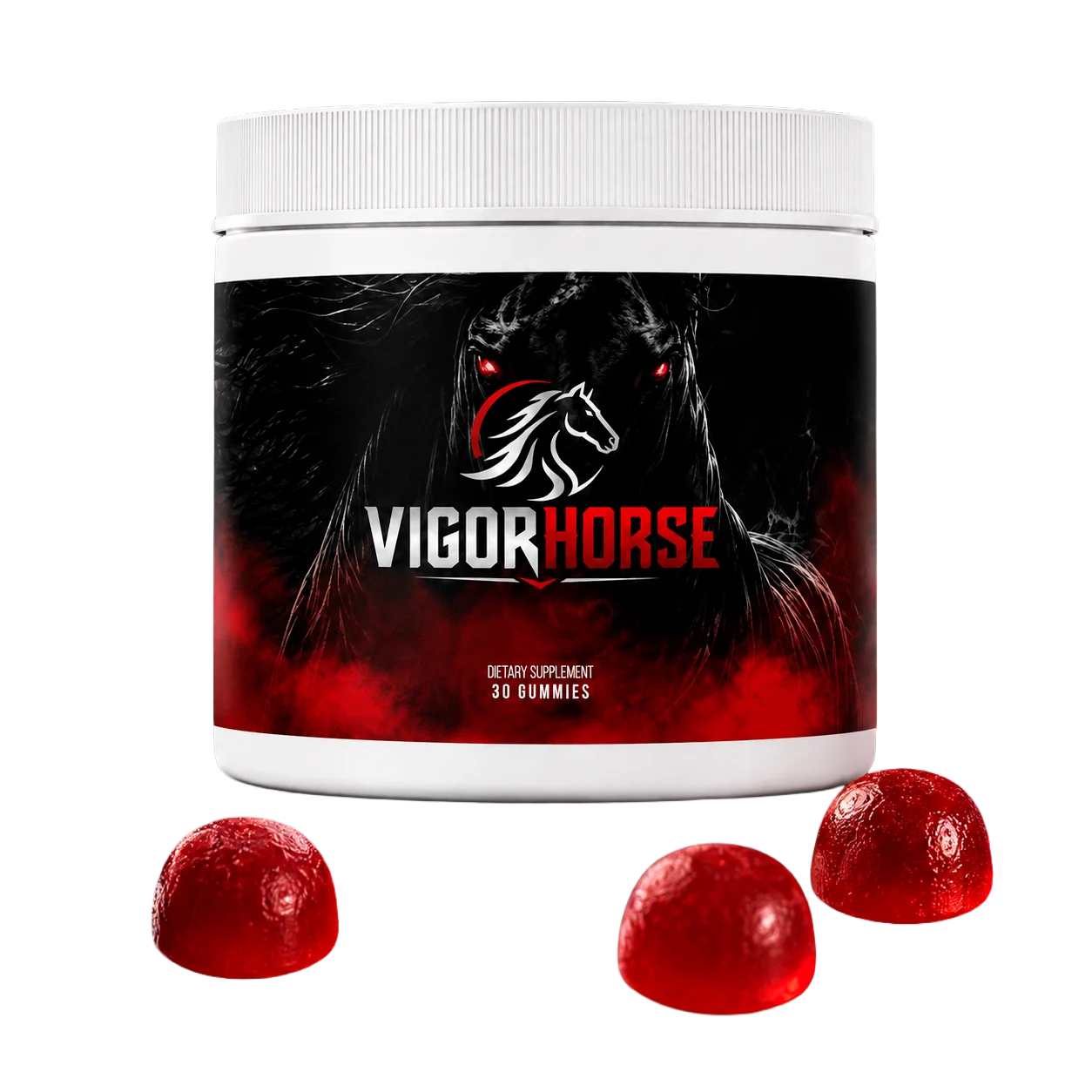
Every printed row, the blend line, the nine names beneath it and the three footnotes, transcribed from the artwork exactly as it prints them.
One bottle $89 · six bottles $294 · 60-day money-back guarantee
Order VigorHorse On The Official WebsiteOne gummy a day · 30 per jar · lot VIG-26/GO-6654
The arithmetic for this jar
The panel prints no amount for green tea extract, and it does not say how much EGCG the extract carries. But two facts on the label let you box the figure in.
The first is the label rule that names in a proprietary blend are listed in descending order of predominance by weight. The order on this jar is muira puama, maca, catuaba, green tea extract, caffeine (5 mg), ashwagandha, L-arginine, tribulus and horny goat weed. Green tea extract is printed ahead of caffeine, which is printed at 5 mg, so if the label follows the rule the extract weighs at least 5 mg. The second fact is the total, 82 mg for all nine. Four names, muira puama, maca, catuaba and green tea, each weigh at least as much as green tea, and the 5 mg of caffeine and four smaller names must fit into the same 82 mg. Four green-tea-sized shares plus 5 mg cannot exceed 82 mg, so green tea extract weighs under about 19 mg.
EGCG is only one part of an extract, so the EGCG in a gummy is a fraction of that. Even in the impossible case where the extract was nothing but EGCG, the ceiling stands. Set it against the figures from the papers.
| Benchmark from the papers | EGCG per day | Times the largest possible green tea extract weight (about 19 mg) | Times the whole 82 mg blend |
|---|---|---|---|
| Lowest amount in USP's case reports | 140 mg | More than 7 | About 1.7 |
| Hu safe intake, solid bolus dose | 338 mg | More than 17 | About 4.1 |
| Doses that raised liver enzymes in EFSA's trial evidence | 800 mg | More than 40 | About 9.8 |
One gummy a day. Ratios are the benchmark divided by the ceiling, rounded down for the extract and to one decimal place for the blend.
Notice how conservative that is. The right-hand column assumes the entire blend, all nine names, is pure EGCG. Even then the smallest case-report amount is about 1.7 times what the jar contains. This is the ordinary consequence of putting a compound with a hundreds-of-milligrams safety literature into a gummy with an 82 mg total.
A more everyday comparison
The EFSA figures give another way to put the number in proportion. Its abstract says green tea infusions provide roughly 90 to 300 mg of EGCG a day to the average European drinker. Even taking the largest possible extract weight on this jar, a little under 19 mg, and pretending it was all EGCG, one gummy is between about a fifth and a sixteenth of what an ordinary tea drinker takes in from the cup. That is not a claim that the gummy is equivalent to tea. It is a reminder of how small a shared blend total is beside a habit most people never think twice about.
What the arithmetic does not settle
- It rests on the label rule. If the printed order is not followed, the bounds move. The order is what the label prints and it is the only thing available to work with.
- Idiosyncratic reactions are not proportional to dose. The 2015 review says patient factors seem to be predominant, and USP describes wide variability in susceptibility. A small amount lowers the odds. It does not remove them.
- Exposure adds up. If you also drink strong green tea or take another product containing green tea extract, this jar is not your only source. Nothing on the label lets you add it up for you.
- A nine-name blend cannot be pulled apart. The 2017 review's point applies here: in a multi-ingredient product the responsible component is usually unknown, so a reaction to the jar could not be attributed to green tea or to anything else in it.
- Caffeine travels with it. The 5 mg caffeine row is printed separately and is covered in the caffeine article. Whether the green tea extract carries any caffeine of its own is not printed.
What a sensible reader does with this
Three things follow, none of them dramatic.
Know your own liver history. The label's warning already says that if you take medications or have a medical condition you should consult your doctor before using, and a previous liver problem is exactly the kind of thing that sentence is for. USP's wording for concentrated extracts is blunter, and it is reasonable to treat a known liver problem as a reason to ask first.
Know the symptoms, and act on them. The ones USP names are abdominal pain, dark urine and jaundice, meaning yellowing of the skin or eyes. The label says to discontinue use and consult your doctor if any adverse reaction occurs, and that is the right response to any of them.
Count your other sources. If you take a weight-loss or fat-burner product, or drink green tea heavily, tell whoever advises you about supplements. The network cases described above involved weight-loss products, not men's vitality gummies.
Taking the gummy with a meal is consistent with the label, which sets no timing. The how to use page treats the timing as your decision, and the pharmacopeia's advice for concentrated extract, not to take it on an empty stomach, costs nothing to borrow. That is a judgement, not a requirement, and nothing in this article is a substitute for the conversation with your own clinician.
Green tea extract has a real liver literature, and it is about hundreds of milligrams of EGCG, mostly as concentrated extract in large bolus doses. This jar's label caps the extract at under about 19 mg, and the entire blend at 82 mg. That is a large margin, and it is still arithmetic on a printed order, not a measurement of a gummy.
References
- Navarro VJ, Khan I, Björnsson E, et al. Liver injury from herbal and dietary supplements. Hepatology. 2017;65(1):363-373. PMID 27677775. https://pubmed.ncbi.nlm.nih.gov/27677775/
- EFSA Panel on Food Additives and Nutrient Sources added to Food (ANS), Younes M, Aggett P, et al. Scientific opinion on the safety of green tea catechins. EFSA J. 2018;16(4):e05239. PMID 32625874. https://pubmed.ncbi.nlm.nih.gov/32625874/
- Hu J, Webster D, Cao J, et al. The safety of green tea and green tea extract consumption in adults - Results of a systematic review. Regul Toxicol Pharmacol. 2018;95:412-433. PMID 29580974. https://pubmed.ncbi.nlm.nih.gov/29580974/
- Oketch-Rabah HA, Roe AL, Rider CV, et al. United States Pharmacopeia (USP) comprehensive review of the hepatotoxicity of green tea extracts. Toxicol Rep. 2020;7:386-402. PMID 32140423. https://pubmed.ncbi.nlm.nih.gov/32140423/
- Mazzanti G, Di Sotto A, Vitalone A. Hepatotoxicity of green tea: an update. Arch Toxicol. 2015;89(8):1175-91. PMID 25975988. https://pubmed.ncbi.nlm.nih.gov/25975988/
- Zheng EX, Rossi S, Fontana RJ, et al. Risk of Liver Injury Associated with Green Tea Extract in SLIMQUICK(®) Weight Loss Products: Results from the DILIN Prospective Study. Drug Saf. 2016;39(8):749-54. PMID 27189593. https://pubmed.ncbi.nlm.nih.gov/27189593/