VigorHorse Official Website › Blog › Which Maca Is On The Label?
Which Maca Is On The Label? Colour, Drying, Extract And The Word Left Out
Maca is second on this jar's blend line, printed as two words: Maca Extract. The trials behind the name each used something more specific. This article lines up what they used, what the research says about colour, drying and origin, and what the label leaves unsaid.
- Six published human maca trials described their material six different ways: gelatinised maca, maca root, a dry extract, a milled hypocotyl, spray-dried black and red extracts, and a gelatinised maca pill. The label says Maca Extract.
- A 2024 review counts up to seventeen colours of maca and says colour, growing location, cultivation and post-harvest processing all change the nutrition and chemistry.
- In a 12-week trial of 175 people, red and black maca extracts did not behave the same way: mood, energy and altitude-sickness scores were better with red, while black had more macamides and fatty acids.
- The compounds most often studied, macamides, are essentially absent from fresh root and are formed while it dries, so the same root dried two ways is two different products.
- Maca is second on a shared 82 mg line, so it weighs at most about 33 mg, against trial doses of 1,500 mg and up.
Two words on the label, six descriptions in the trials
The jar prints “Maca Extract”. It is second on the blend line, behind muira puama and ahead of catuaba, and it has no amount of its own. If you go to the trials for the ingredient, you will not find anything described in those two words. Each study says what it actually gave people, and they do not agree with each other.
| Trial | How the abstract describes the maca | Amount and length | Who took part |
|---|---|---|---|
| Gonzales and colleagues, 2002 | “Maca Gelatinizada” | 1,500 mg or 3,000 mg, 12 weeks | Healthy men aged 21 to 56 |
| Dording and colleagues, 2008 | Maca root | 1.5 g or 3.0 g a day; a pilot | 20 remitted depressed outpatients, 17 of them women, with SSRI-related sexual dysfunction |
| Zenico and colleagues, 2009 | Maca dry extract | 2,400 mg, 12 weeks | 50 men with mild erectile dysfunction |
| Melnikovova and colleagues, 2015 | Milled hypocotyl of maca | 1.75 g a day, 12 weeks; a pilot | 20 healthy men aged 20 to 40 |
| Gonzales-Arimborgo and colleagues, 2016 | Spray-dried extracts of black or red maca | 3 g a day, 12 weeks | 175 adults at low and high altitude |
| Shin and colleagues, 2023 | Gelatinised maca | Stated as 1,000 mg, two pills at a time, three times a day, 12 weeks | 80 eugonadal patients with late-onset hypogonadism symptoms |
Six published trials, wording taken from each abstract. Only the 2016 abstract names a colour.
Six trials and six descriptions: a gelatinised product, a root, a dry extract, a milled hypocotyl, spray-dried extracts in two colours, and a gelatinised pill. These are not the same material with different names. Gelatinising is a processing step, a milled hypocotyl is the ground root itself, and a spray-dried extract is a concentrate. Five of the six abstracts state twelve weeks, which is a useful point in common, and every amount is in grams or thousands of milligrams.
None of that is a criticism of the researchers. Vague words on a label are normal in this category, and this article is not about hiding anything. It is about what the two words leave open.
Colour is a real variable
Maca is a root vegetable grown between 4,000 and 4,500 metres in the central Andes, and it has been cultivated there for more than 2,000 years. What most buyers do not know is that it comes in colours, and that the colours are not decoration.
A 2024 review in Nutrients titled “Not All Maca Is Created Equal” is blunt about it. Research over the last twenty years has identified up to seventeen colours, or phenotypes, of maca. Black, red and yellow are the predominant ones, with purple, grey and others less common. The colour, the hypocotyl size, the growing location, the cultivation and the post-harvest processing can all have a significant effect on the nutrition and phytochemical content, and the authors say research that separates the colours and their clinical uses remains limited. Their closing plea is that future papers should specify all of these factors for the maca they used. Most of the six abstracts above do not.
Two studies show what “colour matters” means in practice.
In rats, a 2006 study compared three ecotypes, yellow, red and black, over 7 and 42 days. Black maca was the only one that increased daily sperm production over 42 days, and the only one that increased epididymal sperm motility. Red maca reduced prostate weight, which black and yellow did not. The authors concluded that the ecotypes differ in their biological response. Rats are not men, and it is one small experiment, but it is a clean demonstration that colour changes the result.
In people, the 2016 trial is the more relevant one. It gave 175 adults 3 g a day of a spray-dried black or red maca extract, or placebo, for twelve weeks, at low and high altitude. Its primary outcomes included sexual desire, mood, energy, quality of life and a score for chronic mountain sickness. The abstract reports improvements in mood, energy and general health status and a fall in the mountain-sickness score. It also reports the difference the two colours made: effects on mood, energy and the mountain-sickness score were better with red, black extracts had more fatty acids and macamides, and red extracts carried more GABA. Black maca, and to a lesser degree red, reduced haemoglobin only in highlanders whose haemoglobin was abnormally high, and black reduced blood glucose. Both were well tolerated.
The authors put the difference down to the composition of the two varieties. That is the point of this section in one sentence: two colours of the same plant, at the same dose for the same twelve weeks, gave different patterns of results.
Drying is chemistry, not just storage
The compounds that most maca chemistry papers focus on are the macamides. Where they come from is surprising, and it changes how to think about “maca” as one thing.
A 2015 paper in Phytochemistry followed the traditional drying of maca at 4,200 metres over nine weeks and compared it with oven drying in the laboratory. Macamides, it found, are essentially absent from fresh, undamaged tissue. Hypocotyls dried by traditional Andean practices, or by industrial oven drying, contain up to 800 micrograms per gram of dry weight. Freeze-thaw cycles in the open field during drying macerate the tissue and release the free fatty acids that the macamides are built from, and the breakdown of glucosinolates supplies the other half. In short, the macamides are a product of the drying.
A follow-up in 2020 shows how much control the process gives. Drying shredded roots at low temperature, 35 degrees in an oven with controlled airflow, produces benzylamine as the primary product, accounting for up to 94% of the glucosinolate that breaks down, and the yield of macamides against other benzene compounds depends on the ratio of two competing reactions.
A broader 2024 review in Frontiers in Pharmacology reaches the same place from the other side. It says maca's chemical composition varies with ecotype, growth conditions and post-harvest processing, and that the phytochemical profile includes macamides, macaenes and glucosinolates. In plain terms: the same root, harvested at the same time and dried two ways, is two different products, and a trial using one does not automatically describe the other.
See exactly what the jar does print
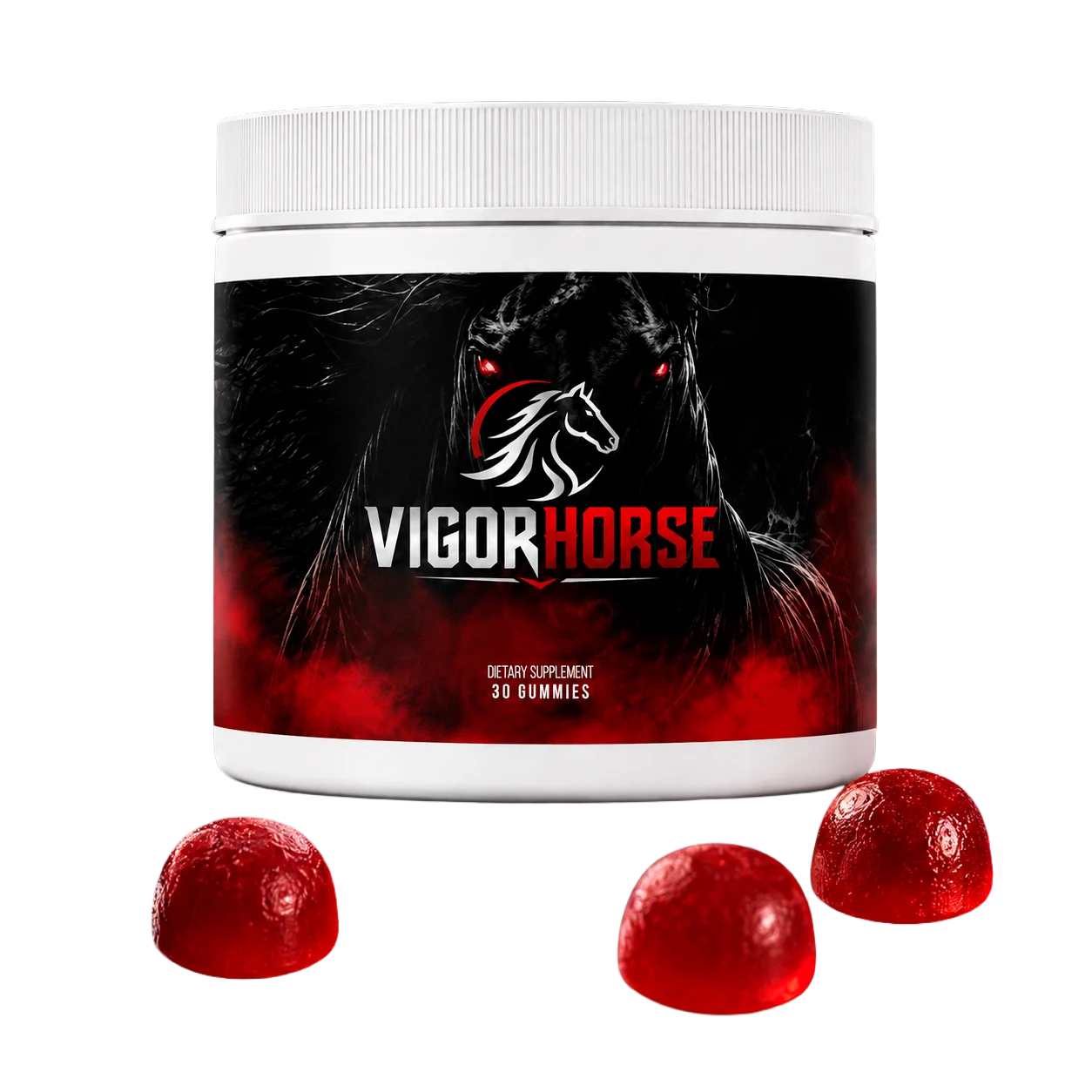
The full Supplement Facts panel, the nine names and their order, transcribed from the artwork exactly as it prints them.
One bottle $89 · six bottles $294 · 60-day money-back guarantee
Order VigorHorse On The Official WebsiteOne gummy a day · 30 per jar · lot VIG-26/GO-6654
What “extract” adds, and what it takes away
Look again at the table. Only two of the six trials used anything that could be called an extract, and one of those two, the 2016 trial, told you the colour. The 2002 desire trial, the one most often cited for this ingredient, used a gelatinised preparation. The label on this jar says extract, and nothing about an extraction ratio, a solvent, a colour, or whether it was gelatinised first.
There is a second, less obvious issue: how anyone could check. A 2021 paper in the Journal of Pharmaceutical and Biomedical Analysis starts from a frank premise. The demand for maca dietary supplements has skyrocketed, and the lack of standard testing protocols for quality control could jeopardise their benefits. The authors note that the reported glucosinolate profiles of maca are inconsistent and incomplete, with some structures possibly misidentified. They developed a direct method and applied it to 42 maca root powder products from 11 manufacturers. They found a consistent ratio of two glucosinolates across every product, glucotropaeolin to glucolimnanthin at 1 to 0.19, which they suggest could be used to authenticate maca and to measure its glucosinolate content, and they suggest that the procedures be incorporated into USP monographs.
Two things follow. First, it is possible, at least for powders, to tell whether a product is maca and how much of the characteristic chemistry it holds. Second, that has to be done by someone, on the product, and it is not done by the word “extract” on a panel. The paper is about root powders rather than extracts, so it cannot be read as a statement about this jar. It shows what an answer would look like.
Where it grows matters too
The label prints “Made in the USA with globally sourced ingredients”. It does not say where the maca was grown, and for this ingredient the question is not idle.
A 2021 study in Toxicology Reports measured arsenic, cadmium, lead, iron and zinc in soils and in the edible hypocotyls of two maca ecotypes across three districts of Junín province in Peru, in areas influenced by mining and metallurgical activity. The mean cadmium (0.32 mg/kg) and lead (0.20 mg/kg) in the maca samples exceeded the values set by the Food and Agriculture Organization and the World Health Organization. The estimated daily intake of each metal was below the oral reference dose, and the non-cancer hazard figures were below 1, so a non-cancer health outcome was judged unlikely. But the estimated cancer risk from arsenic and cadmium was above the tolerable limit for both children and adults, and in one district, Ondores, the arsenic risk for children was above the acceptable limit. The authors call for continuous monitoring, including across ecotypes.
Read that carefully in both directions. It is a study of raw roots from farms near mines in a single region, it is about the people who eat the root as food, and it says nothing about any finished gummy or any commercial supplier. It does show that origin is a variable that changes what is in the root, and that a label saying only “globally sourced” cannot answer it. The testing and quality page makes the wider point that no seal on this jar is a measurement of what is in a gummy.
The amount, briefly
Everything above is about identity. It is worth adding one line about quantity, because the two problems compound. The blend order puts maca second, so it weighs at least as much as catuaba and green tea, each of which must be at least the 5 mg printed for caffeine, and no more than muira puama. Working that through against the 82 mg total puts maca somewhere between 5 mg and about 33 mg per gummy.
The smaller of the two doses in the 2002 trial was 1,500 mg. The most generous maca figure the label allows is roughly forty-five times below that. The full arithmetic is in the 82 milligrams article, and this one adds only the point that a small number of an unspecified maca is a smaller claim than a small number of a named one.
The one word two trials share, and the jar omits
Look back at the trial table for what its two most relevant rows have in common. The 2002 desire trial gave “Maca Gelatinizada”, and the 2023 trial in men with late-onset hypogonadism symptoms gave gelatinised maca. In both, the abstract treats the processing as part of the description of the material, and in the 2023 trial the abstract reports improvements versus placebo in the aging-males symptom scale, the erectile function questionnaire and a prostate symptom score.
The jar does not say gelatinised, raw or extracted in any particular way. That does not make the ingredient different from those trials, and it does not make it the same. It means the closest match between the jar and the strongest human evidence is unknown, and only the manufacturer can say. It is a reasonable question to put to the seller, and a specific one.
Three things that would settle it
- A named colour and preparation. Even one line, such as the variety and whether it is a gelatinised powder or a dried extract at a stated ratio, would tell a reader which of the six trials the jar resembles.
- An amount. Not necessarily a milligram figure for maca alone, which the blend format allows a maker to withhold, but at least the extract-to-plant ratio for maca, which the 567 mg footnote gives only as a figure for the whole blend.
- An assay for this lot. Glucosinolate authentication and a metals screen exist, and a certificate that says what was tested is worth more than a code on a base.
Six questions to put to any maca label
| Question | Why it matters | What this jar prints |
|---|---|---|
| What colour or variety? | Red and black behaved differently in a 175-person trial and in rats | Nothing |
| Which part, and how prepared? | Root powder, gelatinised powder and extract are different materials | “Extract”, with no ratio |
| How was it dried? | Macamides form during drying and are almost absent from fresh root | Nothing |
| How much of it is there? | Every trial in the table used grams | No amount; the blend total is 82 mg for nine names |
| Where was it grown? | Soil and location change what is in the root | “Globally sourced ingredients” |
| Has this product been tested? | Methods exist for glucosinolates, and nothing prints on the jar | A lot number; see the batch verify page for what that does and does not prove |
The right-hand column is what the printed panel and artwork say. It is not a claim that the answers are bad, only that they are not on the jar.
The honest reading
Maca has a better claim to a place on a men's vitality label than most of what shares the line. There are randomised placebo-controlled trials, and the 2002 desire result held up against the hormone data, since testosterone and oestradiol did not differ between the groups. All of that is real.
It also does not travel to a jar automatically. The trials used named, described material at gram quantities, and the research on colour, drying and origin says those descriptions matter to the outcome. A label that gives two words can be honest and still leave the buyer unable to know which of the six trials, if any, it resembles. That is not an accusation. It is the gap between what a jar says and what a trial needs to have said, and it becomes easier to see when you read the two side by side.
References
- Gonzales GF, Córdova A, Vega K, et al. Effect of Lepidium meyenii (MACA) on sexual desire and its absent relationship with serum testosterone levels in adult healthy men. Andrologia. 2002;34(6):367-72. PMID 12472620. https://pubmed.ncbi.nlm.nih.gov/12472620/
- Dording CM, Fisher L, Papakostas G, et al. A double-blind, randomized, pilot dose-finding study of maca root (L. meyenii) for the management of SSRI-induced sexual dysfunction. CNS Neurosci Ther. 2008;14(3):182-91. PMID 18801111. https://pubmed.ncbi.nlm.nih.gov/18801111/
- Zenico T, Cicero AF, Valmorri L, et al. Subjective effects of Lepidium meyenii (Maca) extract on well-being and sexual performances in patients with mild erectile dysfunction: a randomised, double-blind clinical trial. Andrologia. 2009;41(2):95-9. PMID 19260845. https://pubmed.ncbi.nlm.nih.gov/19260845/
- Melnikovova I, Fait T, Kolarova M, et al. Effect of Lepidium meyenii Walp. on Semen Parameters and Serum Hormone Levels in Healthy Adult Men: A Double-Blind, Randomized, Placebo-Controlled Pilot Study. Evid Based Complement Alternat Med. 2015;2015:324369. PMID 26421049. https://pubmed.ncbi.nlm.nih.gov/26421049/
- Gonzales-Arimborgo C, Yupanqui I, Montero E, et al. Acceptability, Safety, and Efficacy of Oral Administration of Extracts of Black or Red Maca (Lepidium meyenii) in Adult Human Subjects: A Randomized, Double-Blind, Placebo-Controlled Study. Pharmaceuticals (Basel). 2016;9(3). PMID 27548190. https://pubmed.ncbi.nlm.nih.gov/27548190/
- Shin D, Jeon SH, Piao J, et al. Efficacy and Safety of Maca (Lepidium meyenii) in Patients with Symptoms of Late-Onset Hypogonadism: A Randomized, Double-Blind, Placebo-Controlled Clinical Trial. World J Mens Health. 2023;41(3):692-700. PMID 36593713. https://pubmed.ncbi.nlm.nih.gov/36593713/
- Gonzales C, Rubio J, Gasco M, et al. Effect of short-term and long-term treatments with three ecotypes of Lepidium meyenii (MACA) on spermatogenesis in rats. J Ethnopharmacol. 2006;103(3):448-54. PMID 16174556. https://pubmed.ncbi.nlm.nih.gov/16174556/
- Minich DM, Ross K, Frame J, et al. Not All Maca Is Created Equal: A Review of Colors, Nutrition, Phytochemicals, and Clinical Uses. Nutrients. 2024;16(4). PMID 38398854. https://pubmed.ncbi.nlm.nih.gov/38398854/
- Esparza E, Hadzich A, Kofer W, et al. Bioactive maca (Lepidium meyenii) alkamides are a result of traditional Andean postharvest drying practices. Phytochemistry. 2015;116:138-148. PMID 25817836. https://pubmed.ncbi.nlm.nih.gov/25817836/
- Esparza E, Yi W, Limonchi F, et al. Glucosinolate catabolism during postharvest drying determines the ratio of bioactive macamides to deaminated benzenoids in Lepidium meyenii (maca) root flour. Phytochemistry. 2020;179:112502. PMID 32871537. https://pubmed.ncbi.nlm.nih.gov/32871537/
- Ulloa Del Carpio N, Alvarado-Corella D, Quiñones-Laveriano DM, et al. Exploring the chemical and pharmacological variability of Lepidium meyenii: a comprehensive review of the effects of maca. Front Pharmacol. 2024;15:1360422. PMID 38440178. https://pubmed.ncbi.nlm.nih.gov/38440178/
- Xu Q, Monagas MJ, Kassymbek ZK, et al. Controlling the quality of maca (Lepidium meyenii) dietary supplements: Development of compendial procedures for the determination of intact glucosinolates in maca root powder products. J Pharm Biomed Anal. 2021;199:114063. PMID 33862504. https://pubmed.ncbi.nlm.nih.gov/33862504/
- Orellana Mendoza E, Cuadrado W, Yallico L, et al. Heavy metals in soils and edible tissues of Lepidium meyenii (maca) and health risk assessment in areas influenced by mining activity in the Central region of Peru. Toxicol Rep. 2021;8:1461-1470. PMID 34401355. https://pubmed.ncbi.nlm.nih.gov/34401355/
- Gonzales GF. Ethnobiology and Ethnopharmacology of Lepidium meyenii (Maca), a Plant from the Peruvian Highlands. Evid Based Complement Alternat Med. 2012;2012:193496. PMID 21977053. https://pubmed.ncbi.nlm.nih.gov/21977053/